> For the complete documentation index, see [llms.txt](https://docs.hedge.video/llms.txt). Markdown versions of documentation pages are available by appending `.md` to page URLs; this page is available as [Markdown](https://docs.hedge.video/postlab-1/features/versioning.md).
# Versioning
PostLab keeps track of all changes made to a document, allowing the whole team to revert those changes from any location. A Team Time Machine, if you will.
## Creating a version
To begin, open a document from within PostLab. Once a document has opened, a new section will automatically appear above the Activity Feed. Here, you can describe any changes you are making to the document:
Add a description of the changes you made to a document, before saving.
After working on your document, return to PostLab to save the changes. Navigate to the `Save your work` section located on top of the Activity Feed. Here, describe the changes you have made and include any additional information that may be helpful for your team members or yourself.
Next, click `Save Changes` . PostLab will then save all changes in the Team Bundle. The time this takes varies and depends on the size of the document and the number of changes made.
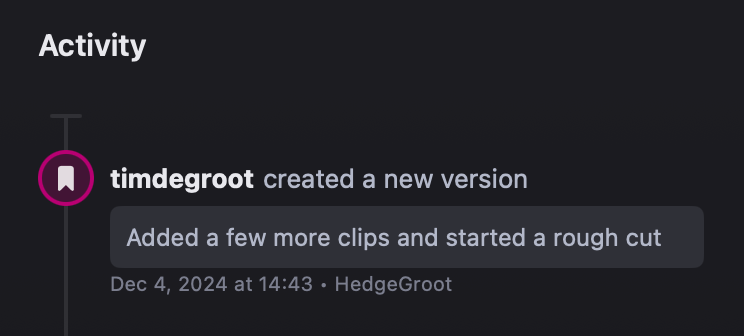
After saving, a new entry appears in the Activity Feed. It contains information about when, where, and by whom this version was made. Quickly identify a version in the Activity Feed by its bookmark icon, colored outline, and title.
A new version is saved.
## Reverting to a previous version
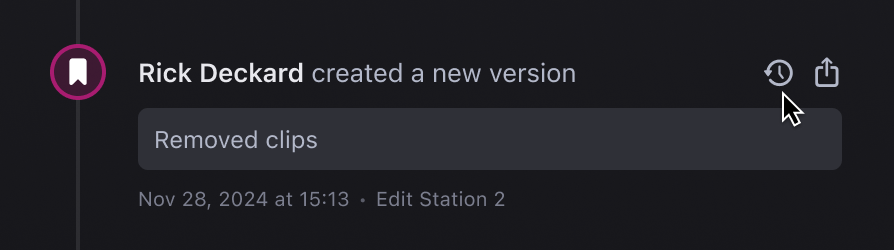
PostLab's versioning capabilities allow you to return to any point in the document's history. You can revert to any version anytime. To revert to a previous version, hover your cursor over the version you want to revert to. Click the Revert icon that appears next to the Export icon.
Revert back to an older version.
An alert will pop up, asking if you are sure you want to make this version the most recent one - click `Revert` to confirm.
A new Activity Feed item with a Revert label will appear at the top, showing that this is now the active and most recent version. Open the document to see it in the state it was saved in the reverted version.
## Opening or exporting a version
Need to jump back in time and grab something that got lost in a newer version?
Exporting a version lets you access a copy without saving a new version. Note: this copy is generated outside of PostLab, which means any changes made to it will not be tracked.
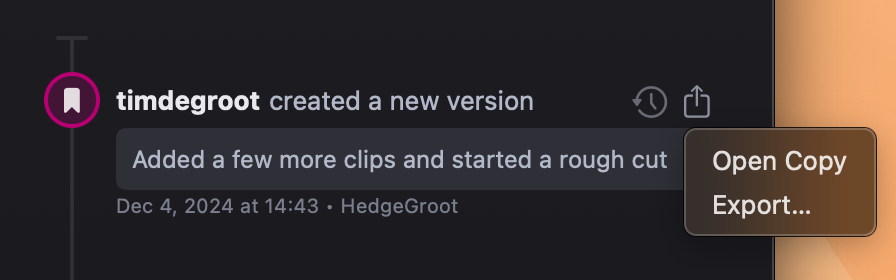
To export a version, hover your cursor over the version and click the Export icon. A menu will open, allowing you to select `Open Copy` to directly access an untracked version of the document, or `Export...` to save the version to your preferred location.
Opening a version.
## Auto Save
While a document is open, PostLab can automatically save your work in the background at a set interval. This is a safety net if you forget to save changes yourself, or the app or your NLE crashes before you do.
To turn it on, go to `PostLab > Team Settings…` (`Cmd+Shift+,`), open the `Versioning` section, and enable `Enable Auto Save`. Set the `Interval` in minutes (5–120). Auto Save only runs while a document is open and changes are made, and it stops as soon as you save or discard.
{% hint style="info" %}
Auto saves don't count toward your version limit, and are shown as new versions in the Activity Feed, which you can revert to.
{% endhint %}
## Pruning Old Versions
Long-running documents can build up a lot of version history over time. Version pruning permanently deletes the oldest versions once a document has more versions than your configured limit, freeing up disk space.
To turn it on, go to `PostLab > Team Settings…` (`Cmd+Shift+,`), open the `Versioning` section, and enable `Enable Version Pruning`. Set `Maximum versions` to how many versions you want to keep (3–999, default 7). Once enabled, PostLab prunes automatically every time you save, always keeping the most recent versions up to that limit.
Enabling version pruning won't go through your Team Bundle and prune all documents. However, you can manually prune a specific document without creating a new version first. Once the pruning setting is enabled, right-click the document and choose `Prune to N Versions`. PostLab asks you to confirm, since this can't be undone.
{% hint style="danger" %}
Pruning permanently deletes old versions and their files from disk. This cannot be undone.
{% endhint %}
Pruned versions show a trash icon in the Activity Feed and can no longer be reverted to, exported, or opened. If an old version is still part of another library's history, because it's linked and nested there, PostLab skips pruning it until that's no longer the case.
---
# Agent Instructions
This documentation is published with GitBook. GitBook is the documentation platform designed so that both humans and AI agents can read, navigate, and reason over technical content effectively. Learn more at gitbook.com.
## Querying This Documentation
If you need additional information that is not directly available in this page, you can query the documentation by asking a question.
Perform an HTTP GET request on the following URL with the `ask` and `goal` query parameters:
```
GET https://docs.hedge.video/postlab-1/features/versioning.md?ask=&goal=
```
`ask` is the immediate question: it should be specific, self-contained, and written in natural language.
`goal` is what the user is ultimately trying to achieve, the reason they need the answer. Sharing it helps GitBook give you a better, more relevant answer. A goal is most helpful when it describes the outcome the user wants rather than restating the question. For example, with `ask=how do I create an API token`, a goal like `automate deployments from our CI pipeline` lets GitBook tailor the answer to that use case.
The response will contain a direct answer to the question and relevant excerpts and sources from the documentation.
Use this mechanism when the answer is not explicitly present in the current page, you need clarification or additional context, or you want to retrieve related documentation sections.