> For the complete documentation index, see [llms.txt](https://docs.hedge.video/llms.txt). Markdown versions of documentation pages are available by appending `.md` to page URLs; this page is available as [Markdown](https://docs.hedge.video/offshoot/features/s3-transfers/configuring-connections.md).
# Configuring Connections
On macOS, configuring connections is also possible via the Terminal app.
{% hint style="info" %}
You'll need to restart OffShoot to apply any changes made with these commands.
{% endhint %}
Connections are stored in these keys:
* `S3AwsConnections`
* `S3GenericConnections`
A connection is structured using the following JSON format:
```json
[
{
"path" : "",
"label" : "",
"endpoint" : "https://s3.eu-central-1.amazonaws.com",
"bucket_name" : "bucket-name",
"accessKey" : "ACCESSKEY"
}
]
```
## Creating a connection
You can create an AWS S3 connection from a JSON file using the structure listed above with the following Terminal command:
{% code overflow="wrap" %}
```sh
defaults write nl.syncfactory.Hedge.Mac S3AwsConnections -string "$(cat /path/to/file.json)"
```
{% endcode %}
The connection's `Secret Access Key` is stored in the login Keychain as an Application password item, which you can create with the following command:
{% code overflow="wrap" %}
```sh
sudo security add-generic-password -a "ACCESSKEY" -s "https://s3.eu-central-1.amazonaws.com/bucket-name" -l "https://s3.eu-central-1.amazonaws.com" -w "secret-access-key" -T "/Applications/OffShoot.app"
```
{% endcode %}
{% hint style="warning" %}
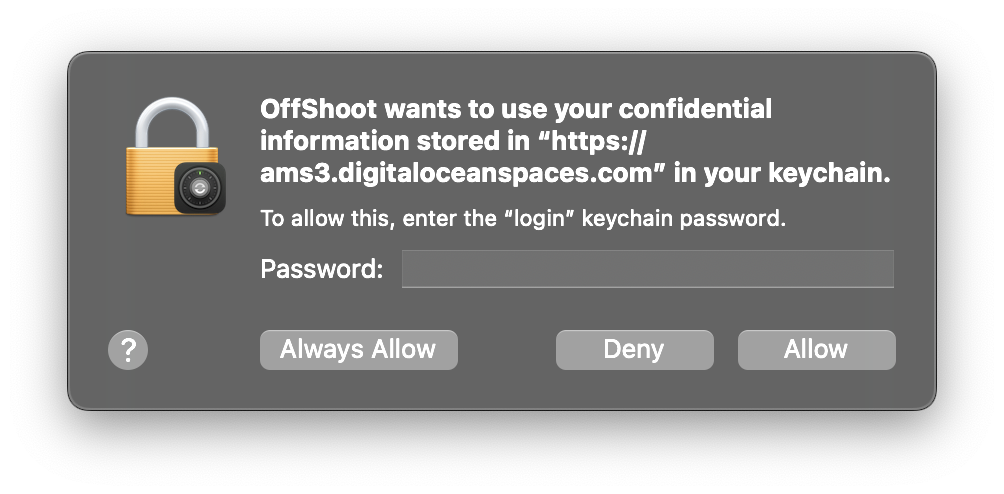
Although OffShoot was allowed access when creating the keychain item, permissions must be allowed again. Please let us know if you discover how to fix this issue.
{% endhint %}
## Checking existing AWS S3 locations
```sh
defaults read nl.syncfactory.Hedge.Mac S3AwsConnections
```
## Write current S3 connections to a JSON file
(For backing up or editing the JSON file.)
```sh
defaults read nl.syncfactory.Hedge.Mac S3AwsConnections > `/path/to/jsonname.json`
```
---
# Agent Instructions
This documentation is published with GitBook. GitBook is the documentation platform designed so that both humans and AI agents can read, navigate, and reason over technical content effectively. Learn more at gitbook.com.
## Querying This Documentation
If you need additional information that is not directly available in this page, you can query the documentation by asking a question.
Perform an HTTP GET request on the following URL with the `ask` and `goal` query parameters:
```
GET https://docs.hedge.video/offshoot/features/s3-transfers/configuring-connections.md?ask=&goal=
```
`ask` is the immediate question: it should be specific, self-contained, and written in natural language.
`goal` is what the user is ultimately trying to achieve, the reason they need the answer. Sharing it helps GitBook give you a better, more relevant answer. A goal is most helpful when it describes the outcome the user wants rather than restating the question. For example, with `ask=how do I create an API token`, a goal like `automate deployments from our CI pipeline` lets GitBook tailor the answer to that use case.
The response will contain a direct answer to the question and relevant excerpts and sources from the documentation.
Use this mechanism when the answer is not explicitly present in the current page, you need clarification or additional context, or you want to retrieve related documentation sections.